
Office Address
A5, AEHS, Lahore, Pakistan
Phone Number
+92 306 77 57 681
A5, AEHS, Lahore, Pakistan
+92 306 77 57 681


 by Aqib Chaudhary
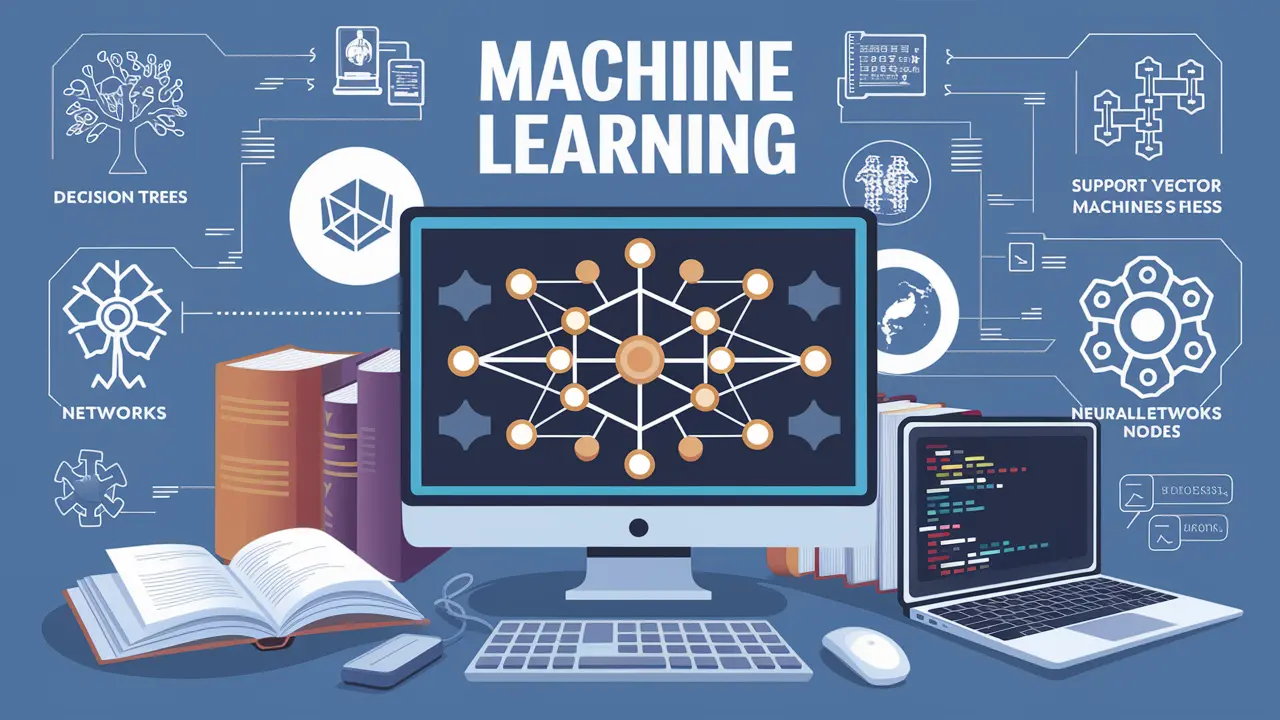
Machine learning is a subset of artificial intelligence (AI) that enables systems to learn and improve from experience without being explicitly programmed. This guide will help you understand the fundamental concepts of machine learning, its applications, and the key algorithms that power it.
Machine learning involves the use of algorithms and statistical models to enable computers to perform specific tasks without explicit instructions. Instead, they rely on patterns and inference from data.
Supervised Learning: Involves training a model on labeled data, where the input and output are known. The model makes predictions based on this training.
Examples: Regression, Classification.
Unsupervised Learning: Deals with unlabeled data. The system tries to learn patterns and the structure from the data.
Examples: Clustering, Association.
Semi-Supervised Learning: Uses a small amount of labeled data and a large amount of unlabeled data for training. This approach combines the strengths of both supervised and unsupervised learning.
Reinforcement Learning: The model learns through trial and error by interacting with an environment and receiving rewards or penalties.
Example: Game AI.
Linear Regression
Logistic Regression
Decision Trees
Support Vector Machines (SVM)
K-Nearest Neighbors (KNN)
Naive Bayes
K-Means Clustering
Random Forests
Neural Networks
Principal Component Analysis (PCA)
Concept: Models the relationship between a dependent variable and one or more independent variables using a linear approach.
Application: Predicting housing prices, sales forecasting.
Concept: Used for binary classification problems. It models the probability of a certain class or event.
Application: Spam detection, disease prediction.
Concept: A tree-like model of decisions and their possible consequences. It splits data into subsets based on feature values.
Application: Loan approval, customer segmentation.
Concept: Finds the hyperplane that best divides a dataset into classes. Works well for both linear and non-linear data.
Application: Image recognition, text categorization.
Concept: Classifies data points based on the k closest points in the training dataset.
Application: Recommendation systems, pattern recognition.
Concept: Based on Bayes' theorem, it assumes independence between predictors. Effective for large datasets.
Application: Email filtering, sentiment analysis.
Concept: Partitions data into k clusters where each data point belongs to the cluster with the nearest mean.
Application: Market segmentation, image compression.
Concept: An ensemble method using multiple decision trees to improve accuracy and control over-fitting.
Application: Feature selection, medical diagnosis.
Concept: Modeled after the human brain, these networks consist of layers of interconnected nodes (neurons) that process data.
Application: Speech recognition, image classification.
Concept: A dimensionality reduction technique that transforms data into a set of linearly uncorrelated variables called principal components.
Application: Data visualization, noise reduction.
Healthcare: Disease diagnosis, personalized medicine, medical image analysis.
Finance: Fraud detection, algorithmic trading, credit scoring.
Retail: Customer segmentation, demand forecasting, recommendation systems.
Transportation: Self-driving cars, route optimization, predictive maintenance.
Entertainment: Personalized content recommendations, video/image recognition.
Data Collection: Gathering data relevant to the problem.
Data Preparation: Cleaning and organizing data for analysis.
Choosing a Model: Selecting the appropriate algorithm(s) for the task.
Training the Model: Feeding the data into the model to learn patterns.
Evaluating the Model: Assessing the model’s performance using metrics like accuracy, precision, and recall.
Tuning Parameters: Adjusting model parameters to improve performance.
Making Predictions: Using the trained model to make predictions on new data.
Scikit-Learn: A Python library offering simple and efficient tools for data analysis and modeling.
TensorFlow: An open-source platform for machine learning, developed by Google.
Keras: A high-level neural networks API, running on top of TensorFlow.
PyTorch: An open-source machine learning library developed by Facebook's AI Research lab.
Accuracy: The fraction of correct predictions out of all predictions made.
Precision: The fraction of relevant instances among the retrieved instances.
Recall: The fraction of relevant instances that have been retrieved over the total amount of relevant instances.
F1 Score: The harmonic mean of precision and recall.